
Biologics for UC and Crohn’s Disease: What’s the Evidence in 2027?
Medically reviewed by Vikram Tarugu, MD, board-certified gastroenterologist. Last updated November 2026.
Living with ulcerative colitis (UC) or Crohn’s disease can mean dealing with symptoms that interrupt work, travel, sleep, and daily life.
The good news is that inflammatory bowel disease treatment has improved greatly.
Biologics are targeted medicines that can help control inflammation, heal the intestinal lining, reduce steroid use, and support lasting remission.
Biologics for UC and Crohn’s Disease Are Not “One Size Fits All”
Although UC and Crohn’s disease are both forms of inflammatory bowel disease (IBD), they affect the digestive tract differently.
This means a medication that works especially well for one person or one type of IBD may not be the best choice for another.
Your treatment should consider disease severity, where inflammation is located, prior medications, other health conditions, safety, convenience, and personal preferences.
Quick IBD Medication Comparison
Biologics work by blocking specific parts of the immune system that drive inflammation:
- Anti-TNF medicines, such as infliximab and adalimumab, target a protein called TNF.
- Vedolizumab works mainly in the gut by limiting certain inflammatory cells from entering intestinal tissue.
- Ustekinumab blocks two inflammatory proteins, IL-12 and IL-23.
- Risankizumab and mirikizumab more selectively target the IL-23 pathway.
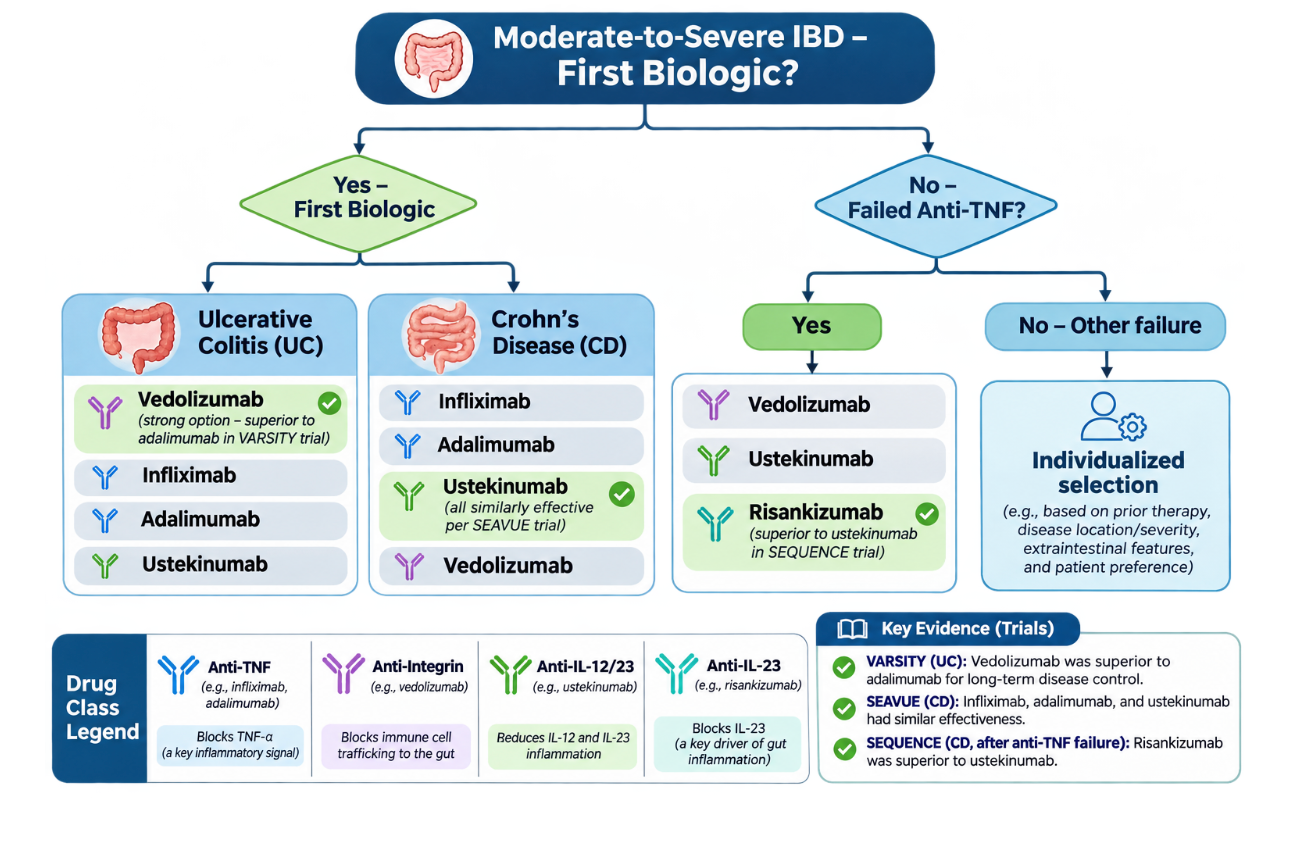
This flowchart summarizes how a first biologic is often chosen for moderate-to-severe ulcerative colitis or Crohn’s disease, including the options after anti-TNF failure and the key trials behind each choice.
Ulcerative Colitis: Vedolizumab Has Strong Evidence
For people with moderate-to-severe ulcerative colitis, vedolizumab is an important option, particularly for patients seeking a treatment designed to work primarily in the digestive tract.
The VARSITY trial directly compared vedolizumab with adalimumab in ulcerative colitis. At one year, more patients receiving vedolizumab achieved clinical remission: 34.2% compared with 24.3% receiving adalimumab. [Gastroenterology]
Current guidance continues to support vedolizumab over adalimumab for induction and maintenance of remission in moderate-to-severe UC. [ACG]
That does not mean adalimumab is ineffective. It remains a valuable treatment for many patients, especially when it fits their medical history, insurance coverage, schedule, or treatment goals.
Newer options are also expanding choices for UC. Mirikizumab, sold as Omvoh, targets IL-23 and is approved for ulcerative colitis. Other advanced therapies may also be considered based on the individual patient.
Crohn’s Disease: More Than One Strong Option
Choosing among biologics for Crohn’s disease can be more complex because Crohn’s may affect any part of the digestive tract and can involve strictures, fistulas, or disease outside the bowel.
In the SEAVUE trial, ustekinumab Crohn’s treatment and adalimumab had similar remission rates at one year: 65% and 61%, respectively. [Gastroenterology]
This supports an important message: several biologics can work well as first-line treatment for Crohn’s disease.
However, prior treatment history matters. In the SEQUENCE trial, patients whose Crohn’s disease had not responded adequately to anti-TNF therapy had better endoscopic remission with risankizumab than with ustekinumab at 48 weeks: 31.8% versus 16.2%. [NEJM]
Endoscopic remission means the bowel looks healed or much less inflamed during a colonoscopy. This is an important goal because symptoms alone do not always show whether inflammation is controlled.
Safety and Personal Fit Matter
No biologic is automatically “best” for every patient. A treatment decision should balance effectiveness with safety and quality of life.
Research from real-world practice suggests anti-TNF medicines, vedolizumab, and ustekinumab often have similar overall effectiveness for Crohn’s disease. [Dig Liver Dis]
Some studies have found lower rates of serious infections with ustekinumab than with anti-TNF medicines in Crohn’s disease. [Clin Gastro Hepatol]
Other practical questions also matter:
- Do you prefer an infusion at an infusion center or an injection at home?
- How quickly do symptoms need to improve?
- Have you used a biologic before?
- Do you also have psoriasis, arthritis, or another immune-related condition?
- What is covered by your insurance plan?
The Bottom Line
There are now more effective options than ever for UC and Crohn’s disease. The best biologic is the one that matches your disease, health history, safety needs, and lifestyle—and helps you achieve meaningful, durable control of inflammation.
Talk With Dr. Vikram Tarugu About Biologic Treatment for IBD
If you are living with ulcerative colitis or Crohn’s disease and wondering whether a biologic is right for you, a gastroenterology evaluation can help.
Dr. Vikram Tarugu provides evaluation and treatment for inflammatory bowel disease in Florida, with locations in Okeechobee and Wellington serving Palm Beach County, South Florida, and surrounding communities.
Schedule a consultation to review your treatment history and discuss which biologic may fit your needs, or call our Okeechobee office at (863) 824-3447 or our Wellington office at (561) 767-8342.
Leave a Reply