
FMT Treatment in Florida: Breaking the Cycle of Recurrent C. diff

Medically reviewed by Vikram Tarugu, MD, board-certified gastroenterologist. Last updated November 2026.
Recurrent Clostridioides difficile infection, often called C. diff, can be exhausting and disruptive. Many patients improve with antibiotics, only to develop diarrhea, cramping, dehydration, and another infection weeks later.
For patients caught in this cycle, fecal microbiota transplantation, or FMT, may be an important treatment option.
Dr. Vikram Tarugu serves patients seeking recurrent C. diff treatment in Okeechobee, Wellington, Palm Beach County, and throughout South Florida.
What Is Fecal Microbiota Transplantation?
Fecal microbiota transplantation transfers carefully screened healthy intestinal microorganisms into the digestive tract of a patient whose gut microbiome has been disrupted.
The gut microbiome contains trillions of bacteria that support digestion, immune function, vitamin production, and protection against harmful germs.
Antibiotics can be lifesaving, but they may also reduce the healthy bacteria that normally keep C. diff under control.
When this protective balance is disrupted, C. diff can grow in the colon and release toxins, leading to watery diarrhea, abdominal pain, colitis, dehydration, and sometimes hospitalization.
FMT aims to restore microbial diversity and the gut’s natural defense against C. diff overgrowth.
Why Consider FMT for Recurrent C. diff?
Many people recover from their first C. difficile infection with antibiotics.
However, recurrence is common. Some patients enter a difficult pattern of repeated antibiotic treatment, temporary improvement, and another C. diff episode.
For recurrent C. diff, FMT is one of the most successful uses of microbiome medicine. Studies and real-world clinical experience show high response rates in appropriately selected patients, with treatment focused on reducing the risk of another recurrence.
FMT may be considered when C. diff returns despite appropriate antibiotic treatment. A gastroenterology evaluation can help determine whether FMT, an FDA-approved microbiota product, or another approach is appropriate.
How Is FMT Delivered?
FMT can be delivered through oral capsules, colonoscopy, or rectal administration.
| Delivery Method | Advantages | Considerations |
|---|---|---|
| FMT capsules | Noninvasive; avoids sedation and colonoscopy | May not be appropriate for swallowing disorders, strictures, gastroparesis, or bowel obstruction risk |
| FMT by colonoscopy | Direct delivery into the colon; may allow evaluation for inflammation | Requires bowel preparation, sedation, and standard colonoscopy precautions |
| Rectal suspension or enema | Less invasive; no sedation required | May reach less of the colon than colonoscopic delivery |
| Upper GI tube delivery | Option when lower GI delivery is not feasible | Can be uncomfortable and may carry aspiration risk |
The best delivery method depends on the patient’s medical history, anatomy, severity of illness, prior treatment response, and preference.
How FMT Works: From Healthy Donor to Patient
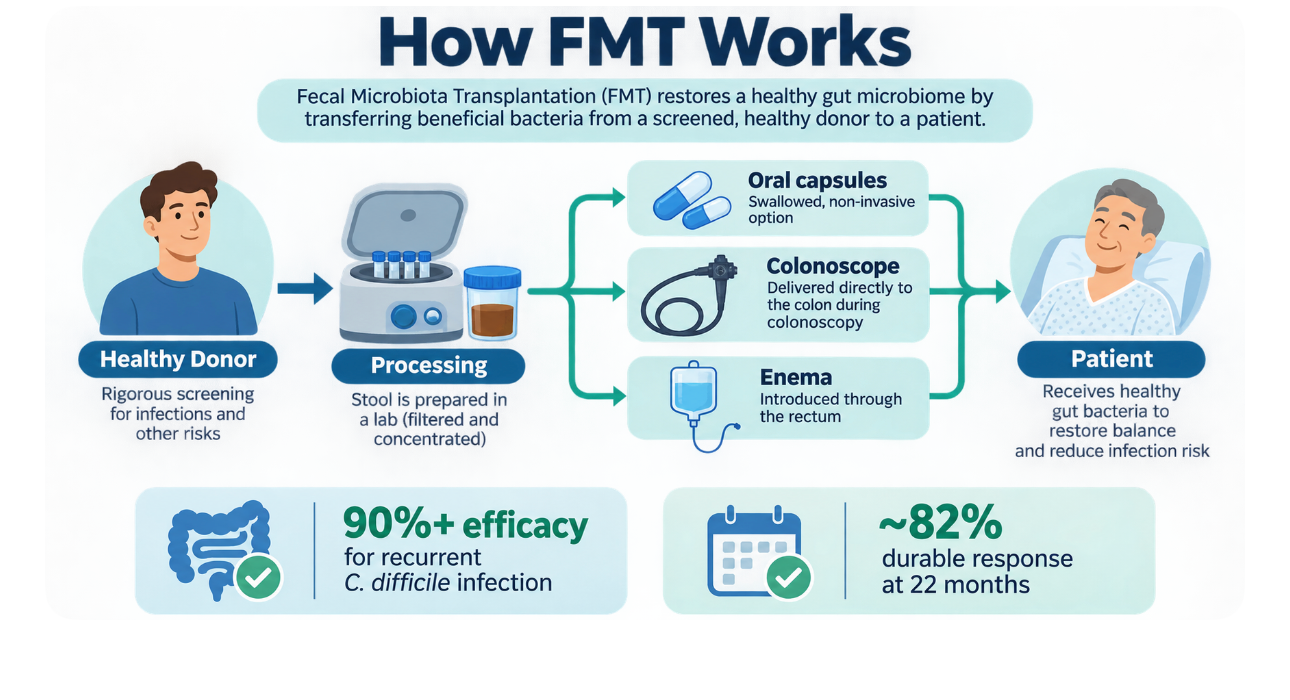
FMT begins with a rigorously screened healthy donor. The material is processed in a laboratory and delivered by oral capsules, colonoscopy, or enema to restore healthy gut bacteria. The infographic highlights more than 90% efficacy for recurrent C. difficile infection and an approximately 82% durable response at 22 months.
Is FMT Safe?
FMT is generally well tolerated, but it is not risk-free.
Short-term effects can include bloating, gas, nausea, abdominal discomfort, and temporary changes in bowel habits.
The main concern is infection transmission through donor material. This is why donor screening is essential. Safe programs use detailed health screening, blood testing, and extensive stool testing for bacterial infections, parasites, viruses, C. diff carriage, and multidrug-resistant organisms.
Home or “do-it-yourself” FMT is not recommended. FMT requires appropriately screened material and medical oversight.
FMT Beyond C. diff
Recurrent C. diff remains the strongest and most established use for FMT.
For irritable bowel syndrome, a large 2026 study did not show better symptom improvement with donor FMT than placebo. FMT is not routinely recommended for IBS.
Research in ulcerative colitis is more promising, with some studies showing remission in selected patients. However, results vary, and more research is needed before FMT becomes routine ulcerative colitis treatment.
FDA-Approved Microbiota Products
Two FDA-approved microbiota products are available to reduce recurrent C. diff after standard antibiotic treatment:
- Rebyota is a one-time rectal microbiota suspension.
- Vowst is an oral capsule product containing purified Firmicutes spores, taken over three days.
These products help prevent recurrence after the active infection has improved. They do not replace antibiotics for active C. diff diarrhea.
Frequently Asked Questions About FMT in Florida
What is FMT?
FMT transfers healthy, screened intestinal microorganisms to help restore the gut microbiome.
Does FMT cure C. diff?
FMT can substantially reduce the risk of recurrent C. diff, especially after multiple episodes, but no treatment guarantees that infection will never return.
Is FMT available in Florida?
Patients from Wellington, Okeechobee, Palm Beach County, and South Florida may be evaluated by Dr. Vikram Tarugu for FMT and microbiota-based treatment options.
Are FMT capsules as effective as colonoscopy?
Both can be effective. The best option depends on the patient’s medical history, anatomy, ability to swallow capsules, and procedural risk.
Who should consider FMT?
FMT may be considered for patients whose C. difficile infection returns after appropriate antibiotic treatment.
Talk With Dr. Vikram Tarugu About Recurrent C. diff Treatment
If you or a loved one is struggling with recurrent C. diff, repeated antibiotics may not be enough to break the cycle.
Dr. Vikram Tarugu provides evaluation for recurrent C. diff treatment and FMT options in Florida, with locations in Okeechobee and Wellington serving Palm Beach County, South Florida, and surrounding communities.
Schedule a consultation to review your C. diff history and discuss whether FMT or an FDA-approved microbiota therapy may be right for you.
Leave a Reply